Background: Mr. Sizwe Ronnie MATHEBULA, Deputy Director of the Department of Higher Education and Training of South Africa, wrote an article entitled “Governance Capacity in My Eyes” after participating in the Seminar on Governance Capacity for African Countries organized by the Academy for International Business Officials (AIBO) of the Ministry of Commerce of the People’s Republic of China in 2025.
I. Seminar on Governance Capacity in China
China’s experience made me reflect on the “Governance Capacity”. It is a term we often hear but rarely unpack. What does it truly mean? During my time in Beijing City, Hangzhou City, and Deqing District, I observed how the government effectively executes its responsibilities—from building infrastructure and managing information technology to ensuring smooth public services and long-term planning. The presentation by Ambassador Ma highlighted that China’s success could be attributed to its political system, which is centred around serving the people and sharing prosperity. By preserving its cultural heritage while modernizing its systems, China successfully lifted millions of its people out of poverty. Unlike any other nations that abandoned their traditional governance models, China leveraged its existing structures and adapted them to fuel its rapid industrialization. One of the key takeaways for Africa is the importance of leveraging its natural resources and human capital-the youngest workforce in the world- to drive sustainable development. I believe a cheap labour model in Africa can develop the continent by attracting investment.
II. Speed of reform
One of the most striking observations from my time in Beijing was the scale and pace of development. Within just three decades, China was able to get its people out of poverty. I vividly recall witnessing the construction of massive skyscrapers with new structures seemingly emerging every day. Hangzhou city, boasts an impressive skyline, characterized by modern skyscrapers that add to its unique appeal. However, it was not just the large-scale infrastructure projects that stood out, the efficiency of public transportation was equally remarkable. The subway system, the largest I have ever seen, was clean, fast and easy to navigate. The well-planned transportation network coupled with seamless urban development, reflects a people-centered governance approach that prioritizes effective planning, resource allocation, and smooth execution. This experience underscored the meticulous coordination required to achieve such rapid yet sustainable progress.
III. Efficiency and technological advancements
Beyond large-scale infrastructure, I was particularly impressed by the efficiency of everyday public services. A visit to Wusi Village, which I refer to as a “5-star village”, was especially insightful. The village is managed through advanced IT systems, ensuring a well-organized and sustainable living environment. The residents appeared content, and the surroundings were exceptionally clean, with well-preserved natural landscapes that blew my mind with how it is managed through IT systems. I had the opportunity to explore a local market, which further highlighted a balance between technological innovation and traditional community living.
IV. Governance and strategic planning
During the seminar, we attended several insightful lectures and discussions on China’s dynasties and their influence on the country’s political systems and governance under communism. A key takeaway was the success of China’s long-term development and educational planning, which has played a crucial role in its progress. It became evident that China places significant emphasis on strategic thinking, effective policy implementation, and rigorous monitoring and evaluation systems. For instance, lectures on China’s green policies highlighted innovative initiatives such as air purification in desert regions to promote sustainable growth. This reinforced an important lesson: governance capacity is not just about responding to challenges but also anticipating and proactively planning for the future. The ability to develop and execute forward-thinking policies such as green insurance programs for organizations demonstrates China’s commitment to sustainability, backed by substantial government investment.
V. Challenges and areas of improvement
Of course, no system is without its challenges. One notable issue is air pollution, which remains a significant concern. However, China is making remarkable progress in tackling climate change and environmental conservation, as highlighted in the presentations. The country’s global leadership in climate action reflects its ongoing efforts to balance economic growth with sustainability.
Another key challenge is rapid urbanization. Discussions during the seminar explored how the Chinese government addresses these challenges through innovation planning for small-town development and strategic urban policies. The ability to manage this growth efficiently while ensuring sustainable development in an area is a prime example from which many developing countries can draw valuable lessons.
VI. Conclusion
My time in China gave me a much clearer understanding of what “Governance Capacity” means in practice. I saw a government capable of building impressive infrastructure, providing efficient public services, and engaging in long-term planning that the people of China have bought into.
China provides an achievable and sustainable developmental model for African nations. Africa can draw inspiration from China’s capacity to mobilize resources and implement large-scale projects that drive economic growth and improve connectivity. However, African countries must adapt these lessons to their unique contexts, focusing on sustainable development, transparent governance, and inclusive growth.
Regarding cooperation with China, and despite the existing platform for cooperation, Africa can strengthen partnerships by prioritizing mutually beneficial projects that align with its development needs and goals. These partnerships can promote technology transfer, skills development, research and innovation, and industrialization while also ensuring that they promote environmental sustainability and address social inequalities. Furthermore, Africa can leverage its relationship with China to foster Global-South cooperation, learn from China's experiences in poverty reduction and economic transformation, and negotiate agreements that promote fair trade and equitable development.
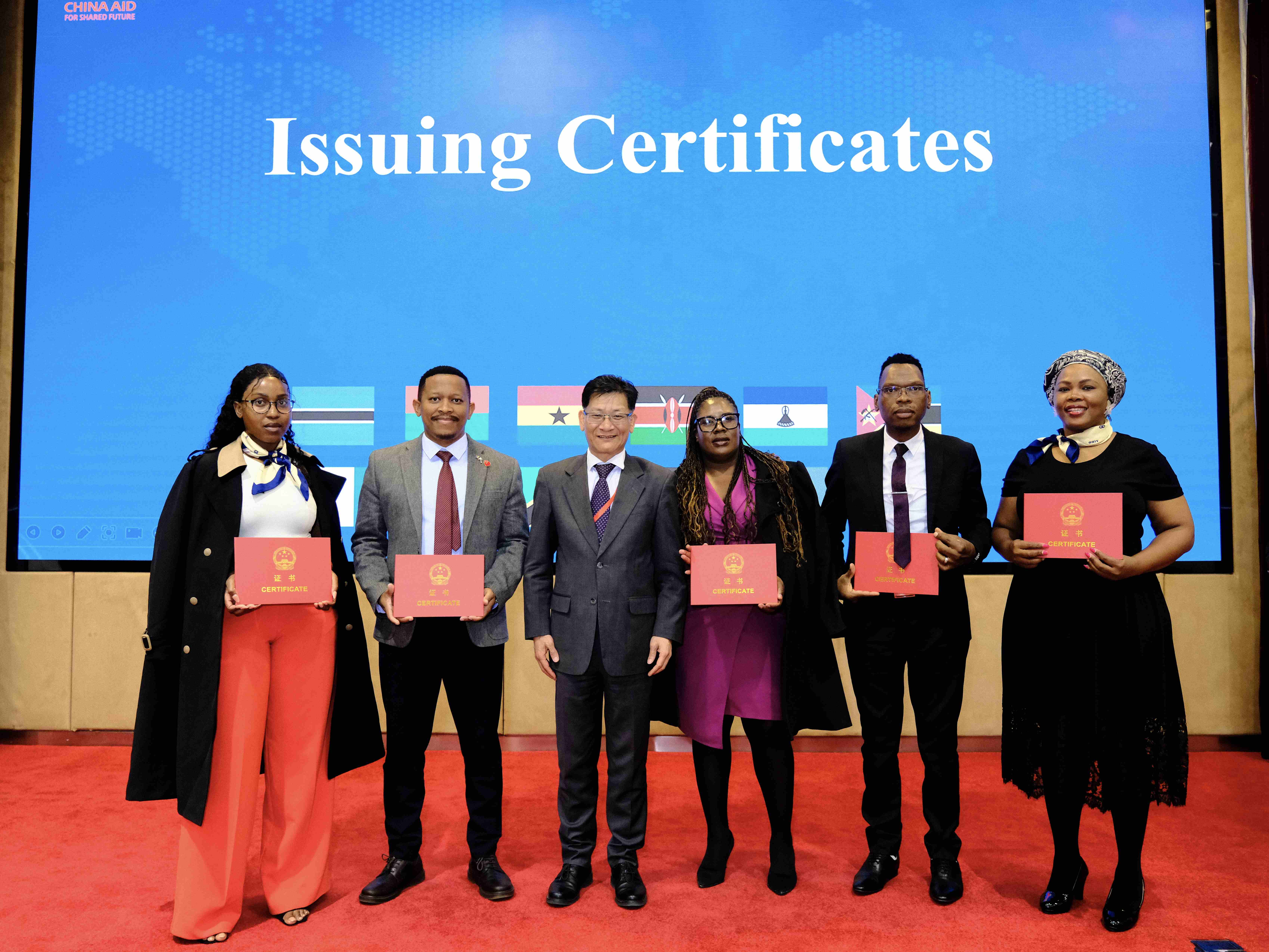
Mr. Sizwe Ronnie MATHEBULA (the second from the left)


