Background: Ms. Ikobeng Gracious SELELO, Key Member of the AP Party in Botswana, wrote an article entitled “Governance Capacity in My Eyes” after participating in the Seminar on Governance Capacity for African Countries organized by the Academy for International Business Officials (AIBO) of the Ministry of Commerce of the People’s Republic of China in 2025.
My mind drifts back to the first few days at the onset of the seminar. When I think about the theme - what resonates most with me is the core of Governance Capacity, which in my perspective is the implementation or execution of national Modernization. Therefore, what I have deduced about this concept, is that the essence of Governance Capacity is the upliftment of the well-being of a country’s people in a contemporary or modern setting.
With respect to China, Governance Capacity is driven by the vision and the ideals of the Communist Party of China. Some of the ideals that we identified during the lectures include: the CPC’s commitment to rescuing and liberating the Chinese people from abject poverty and suffering; obtaining national independence from foreign powers and liberating the people particularly the working class from a life characterized by social and political turmoil as well as uncertainty; achieving economic prosperity and enabling the ordinary people in China live a happy life.
Based on the aforementioned, Governance Capacity refers to a nation’s ability to determine its own development direction by: reaching a consensus on the goals desired by the people, the key milestones that must be obtained to bring the vision into reality, as well as successfully reaching the goals and upholding the ideals to ensure that the achievements benefit not only the present but also the future.
Governance Capacity does not come up abruptly from nowhere. It is built on profound historical foundation. Some of its roots can be traced back to the Qin Dynasty which unified various vassal states, and managed to establish a unified great empire, which is one of the feats of the Qin Dynasty. What I managed to appreciate is how under the governance model of the Communist Party of China, Governance was less about self-interest and serving one’s belly. It was opposed to individualism which fuels Capitalism. The primary notion was that to propel China forward, Governance must be people-centered. Hence, CPC fought against what they deems as the landlords or the oligarchs who possess the means of production and enrich themselves at the expense of the working class or proletariat.
The CPC also managed to successfully dismantle widespread global western imperialism from the colonialists. They empowered the peasants by redistributing land and horses to reinforce the idea that everyone was equal and entitled to have a life of dignity. This resulted in a revolution against the system of governance with the proletariat at the helm. This demonstrated how the working class played an indispensable role in shaking modern China. It is completely undeniable that the working class played a solid and key role in fighting against Imperialism and breaking the shackles of poverty.
Governance Capacity is a concept that we must wholeheartedly embrace, particularly in Africa. This continent, in my perspective, should be dominant, given the magnitude or size of the Continent, the abundance of natural resources and global landmarks, the large and increasingly youthful population. What we lack is what China has mastered years ago: the political will and Governance Capacity to prioritize the needs of the majority over those in the upper echelons of society, for the prosperity of the majority is prosperity of all. The African Continental Free Trade Agreement and the China-Africa cooperation bring a renewed sense of hope regarding the future of Africa.
I have learned about the Belt and Road Initiative and how it would be instrumental in advancing the interests of both Africa and China. This initiative has already advanced and will continue to promote industrialization and the development of infrastructure like hospitals, and roads in remote areas. It will also serve as a beacon of peace and development according to some of our facilitators. I generally share the same sentiment. I believe that like-minded nations should work hand in hand in accomplishing shared mandates. This could not be more true for African nations and their collaboration with China as it has, thus far, borne much fruit. However, I would be reckless not to have any reservations about this friendship. History informs us of how the “white masters” nearly stripped Africa of its riches under the pretext of modernization and helping Africa to develop. Much of the Continent’s problems can be traced to colonial times and the era of the Trans-Atlantic slave trade. I do not by any means suggest that the partnership is similar. In fact, to the contrary. What I am saying is that, in my view, those who do not learn from history are bound to repeat it.
The China-Africa cooperation is and could continue to be exponentially beneficial for both parties in the long run. However, it causes no harm to be cautiously optimistic. In my eyes, if there is one thing that Africa and by extension Botswana can learn from China, it is how to aggressively pursue all the goals that advance national prosperity. All of this can be achieved by Governance Capacity. We should have the political will to reach all of our objectives to propel the interests of the country forward. This is one of the main reasons why China leads in all fronts. In the technological and economic fields, China’s dominance is irrefutable. It has grown in leaps and bounds, which is not only commendable but holds promise for a new global system, one that is not dominated by one or two economic and political super powers, but creates a level playing field for all nations with a desire for modernization.
In my eyes, if we African Countries can do away with Kleptocracy, Corruption and if we can stop being held ransom or being at the behest of other countries, we too can grow and have a success story akin to China’s. If we can benchmark against China’s wins and develop a fair, just and equitable Governance model, characterized by integrity and sustainability, we can build a better future today.
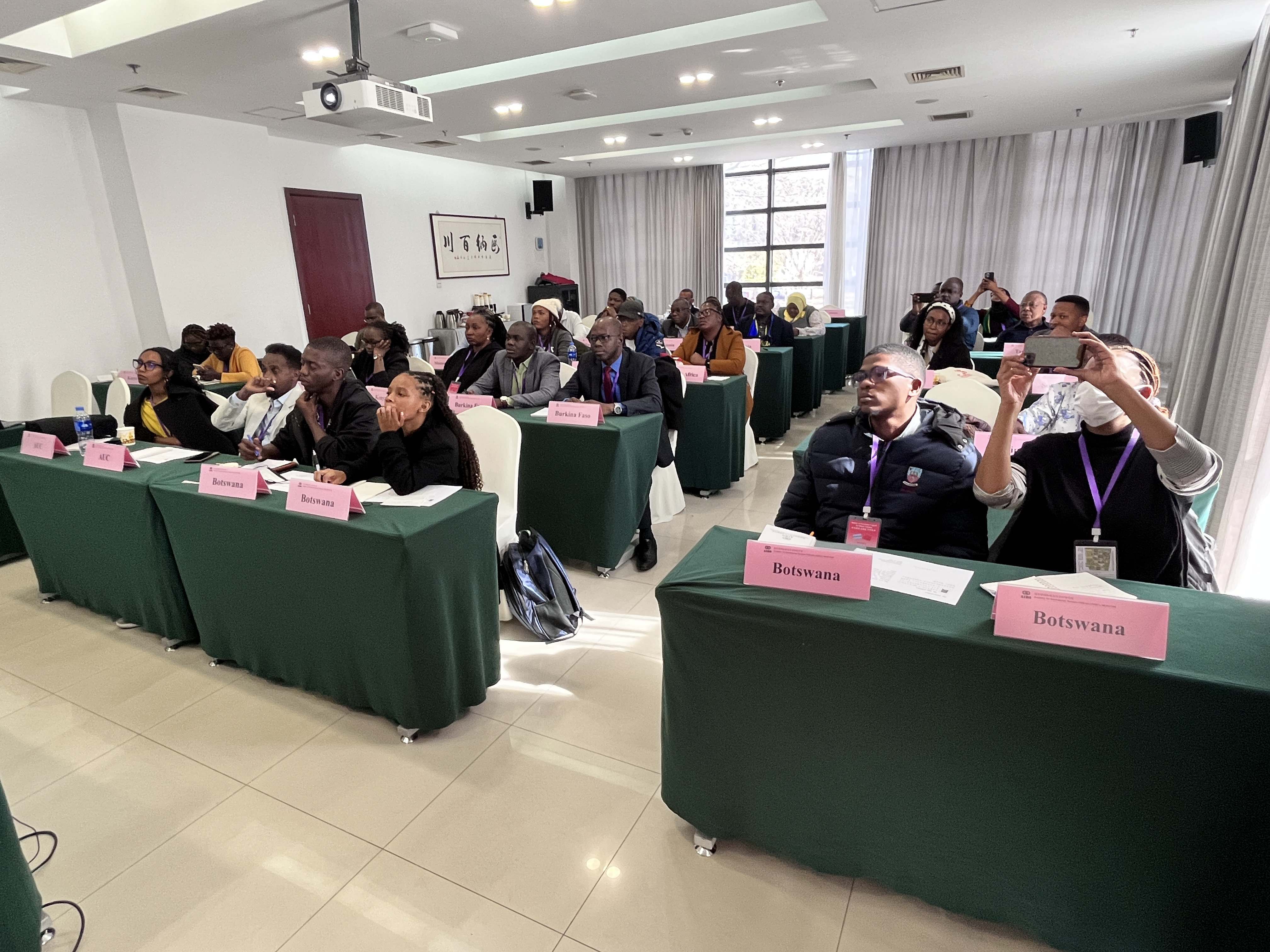
Ms. Ikobeng Gracious SELELO (the fourth from the left in first row)


