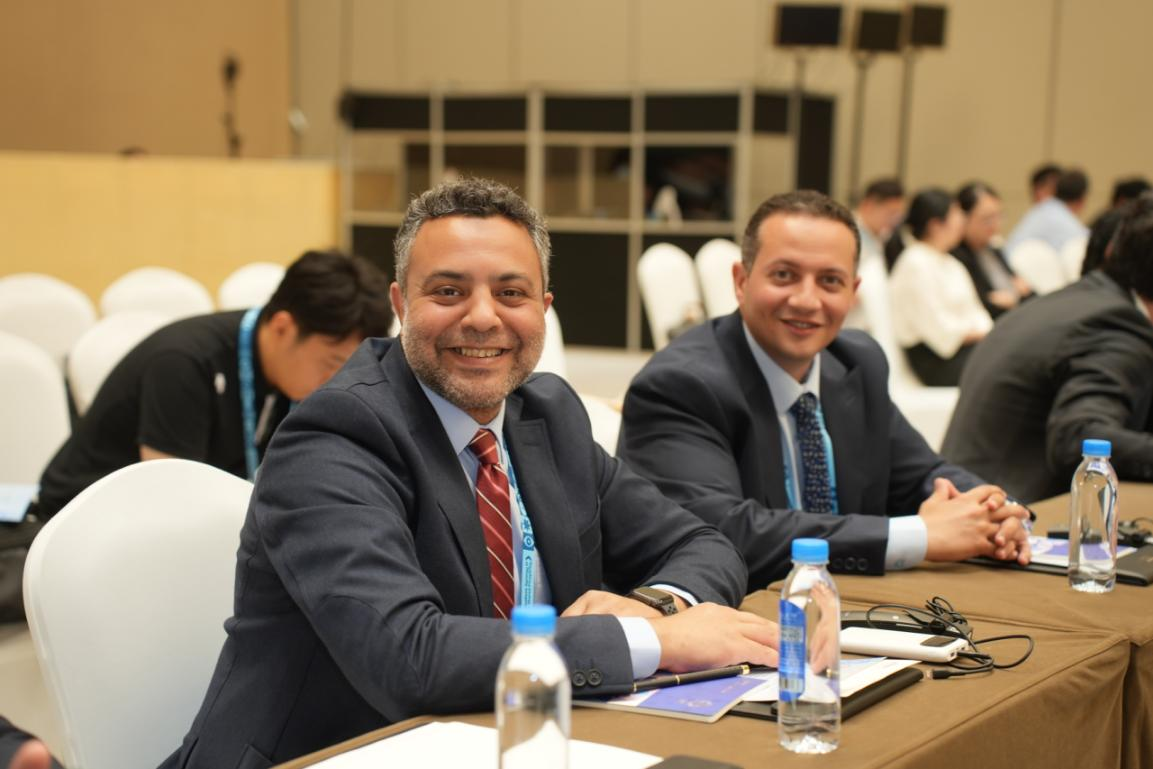
China: From Diligence to Intelligence
Name: Khaled Hussein
Country: Egypt
Seminar on Port and Waterway Planning and Construction for Developing Countries
With over 5,000 years of history and development, China has set a valuable development model for developing countries. In recent decades, it has scored remarkable feats in industrial infrastructure construction and global trade connectivity, bringing hope and a feasible path to prosperity for emerging economies.
During my two-week trip, I kept wondering how China realized comprehensive industrial, commercial and social progress within a short timeframe. After observation and reflection, I attribute its success to two core strengths: diligence and intelligence.
Diligence: Sustained, Focused Hard Work
Diligence means persistent, disciplined long-term efforts rather than meaningless busyness, laying the groundwork for all major achievements.
The spirit of diligence runs through China’s history and modern development. Ancient Chinese built the Great Wall and created numerous inventions; today, massive infrastructure projects embody this trait. Ningbo, a national pilot city for smart ports, boasts non-stop operating cranes, orderly logistics and coordinated staff. Its digital port and smart logistics systems are fruits of consistent daily hard work, not luck.
Diligence also permeates Chinese society. Volunteers offer all-round assistance at airports, banks and schools. Tidy streets, punctual public services and dedicated workers reflect widespread collective solidarity, a core shared value of Chinese people.
Coupled with diligence is the public’s kindness and generosity, which left me deeply touched through three personal encounters:
A Qingdao taxi driver insisted on gifting me a solar-powered astronaut ornament I admired in his car.
A Beijing pharmacy clerk patiently guided me to a herbal store and contacted it in advance to check stock for my joint-relief herbs.
A young Qingdao resident bought me a bottled coffee from a supermarket after learning no cafes were open late when I asked for directions.
These trivial warm gestures left an unforgettable impression on me.
Intelligence: Strategic, Smart Innovation
Intelligence here refers to the capacity to learn, adapt, solve complex issues and make long-term strategic plans, knowing both how to toil and how to work efficiently. Unlike many countries with short election-cycle planning, China formulates decades-long development strategies including the Belt and Road Initiative, 2035 Vision and dual-circulation economy.
Ningbo integrates traditional manufacturing with AI and robotics. Its "Yong e Tong" big data platform simplifies customs clearance and logistics, while "Port Cloud Loan" supports small port enterprises. Qingdao, home to Haier and top breweries, applies intelligent management in logistics, quality control and low-carbon port operations, and maps out clear layouts for integrated circuits, VR, biopharmaceuticals, hydrogen energy and other emerging green industries. Chinese manufacturers keep upgrading product design, transportation and after-sales services instead of merely mass-producing goods.
Smart technologies have become daily necessities in China: mobile payments, high-speed railways, facial recognition boarding and intelligent traffic systems solve practical problems like traffic jams and inefficient transactions. Citizens also display strong social intelligence—they independently propose solutions and help one another when troubles emerge. During my stay, Ningbo, Qingdao and Beijing rarely suffered severe congestion; Qingdao Metro’s well-designed space effectively avoids overcrowding.
The Synergy of Diligence and Intelligence
China never separates diligence and intelligence, but combines the two to tackle all challenges.
Take poverty alleviation as an example. World Bank data (2022) shows China lifted nearly 800 million people out of extreme poverty in 40 years, accounting for three-quarters of global poverty reduction. This outcome relied on diligent grassroots officials stationed in remote villages, as well as data-driven targeted poverty relief policies and economic restructuring. Environmental protection follows the same logic: residents volunteer for tree-planting and river cleaning, while the state invests heavily in solar, wind power and new energy vehicles.
Ningbo balances industrial growth and ecological restoration; Qingdao ports cut emissions while raising cargo throughput. Both cities rely on both manual efforts and technological innovation. Facing aging populations, urban-rural gaps and income disparities, China rolls out smart pension systems, vocational training and rural digital infrastructure with the dual support of hard work and scientific planning. Official data (2024) shows China’s 2023 GDP hit 126 trillion yuan with a 5.2% growth rate, showing steady development momentum. Though imperfections exist, the development logic remains clear: combine human diligence with intelligent planning.
From the Great Wall to high-speed railways, from ancient wisdom to artificial intelligence, China advances by retaining diligence while upgrading with intelligence. Diligence builds foundations, and intelligence shapes the future. My field trips to Ningbo and Qingdao fully verified this rule.
China’s development model is no miracle cure but a practical template for developing countries: stay hardworking, think strategically, help one another and pursue long-term development. This path from diligence to intelligence has proven effective.