Seminar on Building the Capacity of Government Officials in Governing and Administering for Developing Countries
By Mustafa Mohamed Salah Mohamed
(Egypt)
This March, Mr. Mustafa Mohamed Salah Mohamed of Egypt returned to China for his third training visit, taking part in the Seminar on Building the Capacity of Government Officials in Governing and Administering for Developing Countries, hosted by AIBO. As a scholar, he steadily deepened his understanding of China’s philosophy of governance throughout the seminar; and as a longtime friend of China, his grasp of, and emotional affinity for, Chinese civilization grew ever deeper. When the seminar came to a close, he set down in writing the observations and reflections of those two weeks, telling in plain language the story of the China and the Chinese people as he saw them. His article is translated and compiled below :
There are countries we come to know through books, others we follow through news broadcasts, and then there are countries we can truly understand only by living among their people. For me, China belonged to the latter. I had long perceived it as little more than an economic powerhouse with factories that never ceased production. Yet, when I visited the country, I discovered that behind its towering skyscrapers and bustling markets lay countless human stories waiting to be told.
From the very first moment of my visit, I realized that China was far more than a nation racing against time. It is a deeply human society whose cultural roots extend far into history. What impressed me the most was not its remarkable urban development or technological advancement, but the Chinese people themselves. I found them to be humble, calm and firmly convinced that hard work is the natural path to achieving one’s aspirations. I did not sense any arrogance about their country’s accomplishments; instead, I witnessed a quiet pride that inspired them to work even harder, as though every achievement marked the beginning of a new journey rather than its destination.
During my three visits to China, I participated in a large number of meetings and dialogue sessions addressing a wide range of political, economic, and social issues. I also took part in field visits to museums, factories, and both state-owned and private companies. These experiences helped provide a clearer understanding of the practical applications and the tangible dimensions of the developmental foundations underpinning China’s experience of national rejuvenation. Perhaps the most distinctive feature of these meetings and visits was the dynamic and substantive discussion surrounding the nature and trajectory of China’s political system, as well as the opportunity to learn about the public policies pursued by China, the challenges faced by the Communist Party of China, and the ways in which it overcame those challenges during my study in AIBO (Academy for International Business Officials). These experiences also offered insight into how the Party has translated and guided its ideas across both material and non-material dimensions in support of the country’s national objectives, while fostering a strong sense of commitment to and belief in those objectives. As a result, the world has increasingly viewed China’s rise across various levels with considerable interest and admiration.
Seeing China through firsthand experience differs profoundly from knowing it through books or the media. The reality is far more nuanced, shaped by the diversity of Chinese society, its rich cultural traditions, and its various social dimensions. There remains a considerable gap between the real China and the image often portrayed in the media. This is precisely why traveling there offers a unique opportunity to discover the country up close and inspires a desire to explore more about its people, culture and way of life.
Despite the differences in language and customs, I never felt like a stranger, as I had expected. A smile became our common language, and the warm welcome served as a bridge across cultural differences. Time and again, the people who I met went out of their way to help me, even though they spoke neither English nor Arabic. Their genuine willingness to assist was stronger than the barriers created by our language differences.
I came to realize this because, from the very first moment of my visit, I made a conscious effort to engage with the Chinese people and understand their perspectives on both domestic and international affairs. I wandered through shopping centers, spent time in public parks, and traveled by bus between different cities. Through these experiences, I encountered a Chinese society whose culture and value system reflected an exceptional degree of civility, discipline and social harmony. Although I did not speak Chinese and was fully aware of the complexities of the language, our interactions were guided by a shared sense of respect and human connection. This was especially evident in their expressions and reactions whenever they learned that I come from Egypt.
As I explored China’s cities, I realized that development is not simply about modern buildings or high-speed railways; it is, above all, a long-term investment in people. Schools, libraries, museums and public parks all reflect a philosophy that places the quality of life on an equal footing with economic growth. I also discovered that the Chinese people maintain a remarkable balance between preserving their history and embracing the future. While their cities advance rapidly toward modernization, nonetheless ancient temples, traditional villages and cultural arts remain an integral part of everyday life. The past walks hand in hand with the future without one overshadowing the other.
Throughout my several visits to China, I became increasingly convinced that success is never achieved by chance. Although I had long followed China’s rise as one of the major actors in the international system, and had studied the Chinese development model extensively, what I witnessed firsthand reinforced many of my existing convictions while also prompting me to reconsider others.
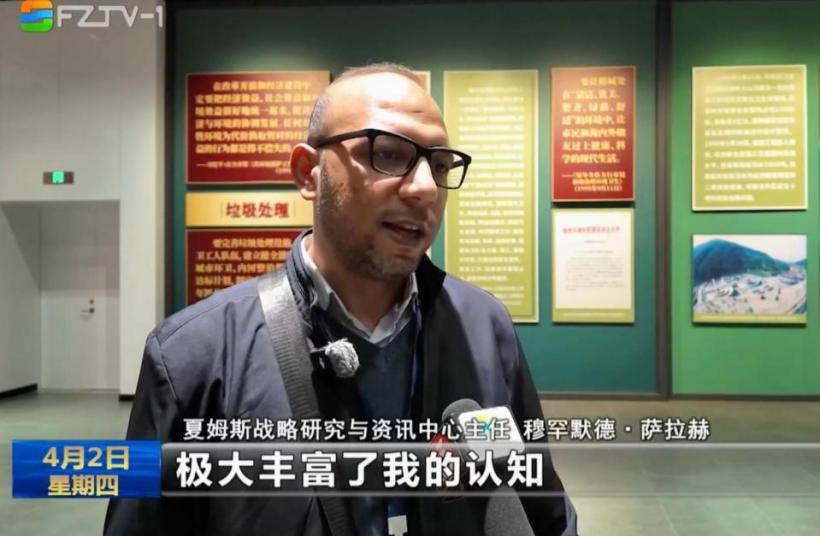
Photo 1: Mr. Mustafa interviewed by local Fuzhou media during the seminar in 2026
From what I observed, China’s remarkable transformation was by no means an easy journey. I came to realize that, underlying the diverse aspirations and daily endeavors of the Chinese people, there is one unifying principle: a deep commitment to hard work, coupled with a strong sense of a shared future. Despite China’s rich cultural diversity and the coexistence of numerous subnational identities, this diversity has served not as an obstacle to development, but as one of its greatest strengths. I saw that national unity and collective commitment to the country’s progress outweigh ethnic or cultural differences. Thus, China’s diverse cultural traditions have become an additional source of strength, enabling the successful implementation of both domestic and international strategies.
This philosophy is reflected in the widely embraced concept of a “shared future”, which, in my view, also shapes China’s foreign policy. It is evident in China’s advocacy of peaceful coexistence and the idea of building a global community with a shared future. This vision has been embodied in a number of Chinese initiatives that seek to strengthen connectivity and cooperation among countries of the Global South while promoting a more inclusive and multipolar international order that accommodates the interests of all nations.
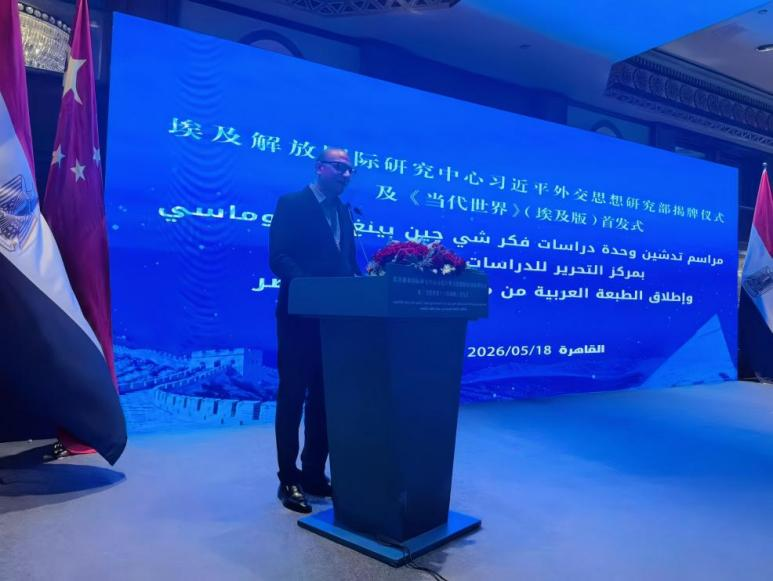
Photo 2: Mr. Mustafa at the unveiling ceremony of the Research Division for Xi Jinping-Thought on Diplomacy at Egypt International Liberation Research Center upon his return home from the seminar in 2026.
As an Egyptian, I discovered many unexpected similarities between the Egyptian and the Chinese people. Both civilizations take great pride in their histories that stretch back thousands of years. Both place immense value on the family, show deep respect for elders, and cherish their national identity. Perhaps that is why I felt that the geographical distance between Cairo and Beijing had little effect on the human closeness between our two peoples.
With regard to human relations, these visits also enabled me to expand my knowledge of many individuals from different countries and to gain a deeper understanding of the diverse cultures of peoples around the world. The visits were not limited to learning about China’s experience in governance, administration, and economic development; they also contributed to the formation of a global community based on greater understanding and rapprochement among peoples. This experience reflected the Chinese concept of a people-to-people approach, which played an important role in strengthening human connections and fostering greater understanding among the participants.
These visits also allowed me and the other participants to gain not only a deeper understanding of China, but also a greater appreciation of the cultural and human bonds that can contribute to strengthening relations among countries. China brought us together through academic sessions and field visits, demonstrating the remarkable capacity of peoples to achieve, at times, what governments may be unable to accomplish in the realm of international political relations.
I returned from China with countless memories, but the most valuable things I brought home could not be packed into a suitcase—they remain with me in my heart and my mind. Today, I feel that I have a new family in every city I have visited across China, a Chinese name of my own—穆承远 (Mu Chengyuan)—and a new perspective that has transformed China, in my eyes, from simply being a major country on the map into an integral part of my intellectual and personal journey.
The sense of gratitude I feel for these experiences and for those who made them possible cannot be adequately expressed through words. At times, language itself proves incapable of fully conveying one’s emotions. I have tried my best to describe only a small part of what I witnessed and experienced, yet there remain many thoughts and feelings in both the mind and the heart that these words cannot fully capture.

Photo 3: Mr. Mustafa’s son wearing a hat marked with the “AIBO” logo


